
(Fingers crossed?)

If humans continue to pump greenhouse gases at our current rate, “we have no reason to think it wouldn’t cause a similar type of extinction,” said Curtis Deutsch, a UW professor and author of the research.
(Fingers crossed?)
If humans continue to pump greenhouse gases at our current rate, “we have no reason to think it wouldn’t cause a similar type of extinction,” said Curtis Deutsch, a UW professor and author of the research.
It’s possible to think of the director as a troll first and serious director second – this is understandable, but regrettable

Last Wednesday, a hundred-plus American theatres hosted a new Lars von Trier film, in its ‘director’s cut,’ for one night only. It’s impossible to imagine any of Von Trier’s still-working contemporaries from, say, the 1996 Cannes Film Festival (where his international breakthrough Breaking the Waves premiered) having their latest films released this way: no such fate awaits Hou Hsiao-hsien or Mike Leigh.
The House That Jack Built (2018) arrived, carnival-barker style, as a viewer-testing orgy of extreme thrills, but it’s actually a very late-period-auteur movie which continues Von Trier’s longtime formal gambit (a widescreen, performance-foregrounding and conspicuously handheld camera style, courting utilitarian ugliness, interpolated with bits reminding you he can go hyper-formal at will) while self-reflexively reorganizing his general preoccupations. A few grody but brief insert shots aside, The House That Jack Built is no serial killer slasher but two and a half hours of uneasy black comedy carried by Matt Dillon’s unreadable (hence unpredictable, hence funny) murderer, leavened with plenty of discussion about church architecture, art and morality.

On this edition of Parallax Views, Dr. Harold Schechter, one of America’s most prolific and voluminous true crime authors, joins the show for a wide-ranging conversation on history’s real-life monsters from Ed Gein to H.H Holmes that attempts elucidate why society is fascinated by serial killers, violent art, murder, and mayhem.

It’s widely known that Marilyn Manson came up with his stage name by combining the monikers of actress Marilyn Monroe and infamous convicted mass murderer Charles Manson. The two names were chosen by Marilyn Manson because he felt that the pair were the two biggest icons of the 1960s. Apparently, the shock rock icon is pretty infamous himself in the mind of Charles Manson, as a postcard from the prisoner to the rock star has been leaked online.
LINK: http://loudwire.com/charles-manson-writes-open-letter-to-marilyn-manson-from-prison/


When I went public with revelations that Cambridge Analytica had harvested 87 million profiles using an app that Facebook had authorized, Facebook’s first reaction was to immediately ban me — not only from Facebook but also from all the other companies that Facebook owns. That means I couldn’t even go on Instagram. All the apps that used Facebook authentication just showed errors — so my Tinder, Uber and countless other apps stopped working.
Within a day of coming out as “the first Millennial whistleblower,” I was deleted from the Internet.
LINK: http://www.papermag.com/christopher-wylie-break-the-internet-2621783738.html

As the UN sits down for its annual climate conference this week, many experts believe we have passed the point of no return
LINK: https://www.theguardian.com/environment/2018/dec/02/world-verge-climate-catastophe
 A piece by Julian Langer, whose blog can be found at https://ecorevoltblog.wordpress.com
————–
“Three minutes. This is it – ground zero. Would you like to say a few words to mark the occasion?” Tyler Durden
As Tyler stood overlooking the heart of civilization he knew he saw a failing empire on the brink of destruction. So Tyler abandons the consumer nesting instinct, in favour of neo-luddite primal anarchy.
Whether or not time and this magical land called the future exists is something for another discussion – I’ll just say that I’m not convinced. But for the purposes of this discussion it seems fair to say that we are three minutes from ground zero. The important thing to remember though is that we are not awaiting the arrival of a nuclear bomb, though Trump, Putin and North Korea appear to be directing us towards that situation. No, we are the embodiment of a thermonuclear cataclysm, a world-ruining piece of machinery, three minutes away from ground zero. So I’ll say a few words to mark the occasion.
Tyler was wrong when he said that our fathers were our models for God; our fathers were merely meant to teach us how to navigate the body of God – the body of the metropolis, the state, the market, civilisation, the Leviathan. But Tyler was correct when he said that God hates us.
After all, what has God, civilisation, the state, the Leviathan, the stranglehold of capitalism brought us? The planet is in ecological ruins. We are plagued by droughts, hurricanes, wildfires intensified by arid conditions and desertification, brought on by agriculture and the deforestation it requires, oil spills, dehabitation, specicde, air unfit to breath and mass extinction. Television feeds us the daily horror of militarism, bombs and politics, along side (m)advertising, supposed reality shows and force-fed comedy spooned down our throats, as we sink deeper into the psychosis of this hyper-real Spectacle – the word of God, the great domesticator.
But in the words of Tyler Durden, “fuck damnation, man, fuck redemption! If we are God’s unwanted children, then so be it!”
If this culture wants us to live lives of death, I propose we rebel, by seeking (near-)Life experiences; that we lose every-Thing to be free to do anything.
How do we do this?
Well if this culture is hell bent on trying to domesticate us all, bringing some wildness to this culture seems the best routeless direction to go down.
With all their attempts to make living in this culture better, most activist projects have served only to make the planetary work machine more bearable for those closest to “radicals”. The revolutionary project is now largely a t-shirt or film. Social anarchists fill potholes and keep this culture going – acts of service to God.
On the other hand, subversive art-focused and psychology-focused milieus, such as Situationists, Discordians, guerrilla ontologists and others which can generally be considered applicable to a post-anarchist practice, have succeeded in creating spaces to release the repressed flow of the wild, within the body of civilisation. This type of practice is that which Hakim Bey (Peter Lamborn Wilson) calls poetic terrorism, and appears to be a means of eco-radicals waging primal war against this world-ruining culture.
Situationists are focused on challenging the psycho-geography of this culture’s everyday normal life, through mediums such as the situationist-prank, which involved turning aspects of capitalism’s everyday-narratives against itself. Discordians and guerrilla ontologists, inspired by the philosophy of Robert Anton Wilson, have often embraced the campaign of Operation Mindfuck, which has focused on art based approaches like performance and guerrilla art, as well as vandalism, practical jokes, reality hacking and hoaxes.
Drawing from these both, in mapping out a loose route for our poetic terrorism, a campaign seems available to us, as agents against this culture, as a means of wild-attack.
What does this look like?
Here are some games –
Modelling glue in the locks of shops, banks and vehicles of world-ruiners. Going into computer shops with fishtank cleaner magnets and destroying the hard drives. Standing on streets with a free hugs sign and giving each person who hugs you a home-made pamphlet on the ecological crisis. Gluing folded up pieces of paper into the coin slots of parking machines and into the card slots of ATMs. Searching for unlocked cars and turning on their lights to drain the battery. Mixing whipped cream, corn flakes, grapes, maple syrup, dish washer fluid and warm water in large quantities in black bags and pouring home-made vomit along streets, in high-traffic pedestrian areas. Standing on the edge and peeing into swimming pools. Leaving kitchen knives in public places covered in fake blood. Graffiti apocalypse poems or surrealist slogans, like “I don’t want to be a wall anymore” on walls, in chalk in public spaces, in sight of on-lookers. Putting itching powder on the toilet paper in public toilets and rolling it back up. Gluing public toilet seats down and putting glue on them. Wearing sandwich boards emblazoned with “the end was yesterday”. Filling wet paper towels with flour, wrapping it up, tying up with a rubber band and throwing flour bombs. Reviving the Existential Negation Campaign. Destroying badger traps or committing other acts of ecotage/monkey-wrenching and turning them into works of art.
These are some of the directions for this project of wild mayhem. With every work of creative-destruction performed a communiqué should be left, as words to mark the occasion.
With this, eco-radical practice escapes the revolutionary model, which is tied to History (the narrative of this culture and its “progress”), without falling into renunciation and becomes an iconoclastic endeavour, full of wild potential. Eco-radicals can challenge believers in this culture’s faith in its ability to maintain everyday normality in ways that are direct and signify a defiant rebellion, without appealing to ideologies and systems, which end up being incorporated and part of that which we hate.
As this operation is intentionally outside of History, there is no start or end date to it. This can be picked up by anyone and dropped as soon as they decide to stop. It has no governing body or even decentralised organisation behind it. It is a wild endeavour, anarchic, free.
So this is it – ground zero. Our operation will be one of wild mayhem. What is to come we cannot know for sure, but the present course only leads to ruin. Disrupting that course, disrupting its ruin of the world and encouraging God’s ruin, through wild poetic terrorism as primal war, seems like a pathway to go down with potential. If you want a future, I will turn again to Mr Durden – “In the world I see – you are stalking elk through the damp canyon forests around the ruins of Rockefeller Center. You’ll wear leather clothes that will last you the rest of your life. You’ll climb the wrist-thick kudzu vines that wrap the Sears Tower. And when you look down, you’ll see tiny figures pounding corn, laying strips of venison on the empty car pool lane of some abandoned superhighway.”
Paul Kingsnorth, a former green activist, thinks the environmental movement has gone wrong. He argues for ‘uncivilisation’

The future for humanity and many other life forms is grim. The crisis gathers force. Melting ice caps, rising seas, vanishing topsoil, felled rainforests, dwindling animal and plant species, a human population forever growing and gobbling and using everything up. What’s to be done? Paul Kingsnorth thinks nothing very much. We have to suck it up. He writes in a typical sentence: “This is bigger than anything there has ever been for as long as humans have existed, and we have done it, and now we are going to have to live through it, if we can.”
Hope finds very little room in this enjoyable, sometimes annoying and mystical collection of essays. Kingsnorth despises the word’s false promise; it comforts us with a lie, when the truth is that we have created an “all-consuming global industrial system” which is “effectively unstoppable; it will run on until it runs out”. To imagine otherwise – to believe that our actions can make the future less dire, even ever so slightly – means that we probably belong to the group of “highly politicised people, whose values and self-image are predicated on being activists”.
According to Kingsnorth, such people find it hard to be honest with themselves. He was once one of them.
We might tell ourselves that The People are ignorant of The Facts and that if we enlighten them they will Act. We might believe that the right treaty has yet to be signed, or the right technology yet to be found, or that the problem is not too much growth and science and progress but too little of it. Or we might choose to believe that a Movement is needed to expose the lies being told to The People by the Bad Men in Power who are preventing The People from doing the rising up they will all want to do when they learn The Truth.
He says this is where “the greens are today”. Environmentalism has become “a consolation prize for a gaggle of washed-up Trots”.
As a characterisation of the green movement, this outbreak of adolescent satire seems unfair. To suggest that its followers become activists only because their “values and self-image” depend on it implies that there is no terror in their hearts, no love of the natural world, nothing real other than their need for a hobby. My experience of green politics is minuscule and secondhand compared with the author’s; all I can say is that the environmentalists I know often share his doubts and yet manage to stick with the cause, believing that their actions may not be totally ineffectual, that something is better than nothing. Most of us would tip our hat to that idea, but Kingsnorth is a passionate apostate with an almost Calvinist certainty that most of the human race, if not all of it, is heading for the fire.
These pieces trace some of his personal and political history. He had a middle-class childhood in the outer London suburbs, with a father who was a “compulsive long-distance walker” – he took his son on marches across the English and Welsh hills. In 1992, aged 19, Kingsnorth joined the protests on Twyford Down against the hill’s destruction by the M3. Aged 21, he was in the rainforests of Indonesia. Like many others, he became an environmentalist “because of a strong emotional reaction to wild places, and the world beyond the human” – like them, he wanted “to save nature from people”. But he also wanted to be different and famous. When he first took it up, green activism “seemed rebellious and excitingly outsiderish”; later, he writes with disappointment, it became “almost de rigueur among the British bourgeoisie”.
Disenchantment arrived when he was in his 30s. In a piece published in 2011, after he has written two or three books as well as columns “for the smart newspapers and the clever magazines”, he decides that his new role model is “not Hemingway but Salinger”. He has done the “big book stuff” – the tours, the extracts run big across the centre pages of mass-market papers. There will be no more Newsnight interviews, no more sitting on the sofa with Richard and Judy (“Jerry Springer was sitting next to me. It was … strange”). All he wants is an acre or two, a house, some bean rows, a pasture, a view of the river. In lists of this kind, renunciation can be hard to distinguish from bragging, and self-sufficiency comes packaged with literary romance.
At the root of this disillusion and retreat – he lives now in a dry-lavatory bungalow in Galway – lay what he calls the “single-minded obsession with climate change” that began to grip environmentalism early in the century. “The fear of carbon has trumped all other issues,” he writes. “Everything else has been stripped away.” Some would see this as saving the planet. Kingsnorth thinks the opposite, that we are destroying the wildest parts of it in the name of sustainability, “a curious, plastic word” that means “sustaining human civilisation at the comfort level that the world’s rich people – us – feel is their right, without destroying the ‘natural capital’ or the ‘resource base’ that is needed to do so”. In more concrete terms, it means wind farms, solar panels and undersea turbines, the renewables that will allow us to carry on business as usual.
Kingsnorth notes that environmentalism is now respectable enough to be embraced by the presidents both of the US (pre-Trump) and Anglo-Dutch Shell, and that a lot of awkward questions have been pushed aside by the drive to reduce carbon. The number of humans, for example, when sustaining a global population of 10 billion, suddenly isn’t a problem, and anyone who suggests otherwise is “giving succour to fascism or racism or gender discrimination”. Instead we make the hills, the deserts and the seas suffer – we’re “industrialising [the] wild places in the name of human desire”.
He writes insightfully about England – presciently, too. “Large-scale immigration is not, as some of its more foaming opponents believe, a conspiracy by metropolitan liberals to destroy English identity,” he says in an essay first published by the Guardian in 2015. “It is a simple commercial calculation. It may cause overcrowding and cultural tension … it is undoubtedly good for growth … if you don’t want the population movement, you don’t get the cheap, easy consumer lifestyle it facilitates. Which will you choose?”
This is Kingsnorth at his plainest and most provocative, but another Kingsnorth is never far away, as romantic in his nationalism as any Victorian storybook when he writes in the same essay: “England is the still pool under the willows where nobody will find you all day, and the only sound is the fish jumping in the dappled light.” This Kingsnorth believes that the human race will eventually die of civilisation, and he wants to create what he calls “Uncivilisation” that will show us a new way to look at human history and endeavour. Stories, he says, are the key.
The book ends with a manifesto: The Eight Principles of Uncivilisation, designed to undermine the myths of progress and human centrality. “Principle 7: we will not lose ourselves in the elaboration of theories or ideologies. Our words will be elemental. We write with dirt under our fingernails.” And so, rather than electric cars and oil in the ground, we are left with a smaller idea of salvation: a little literary movement of the kind that might have gathered around a hand press in a Sussex village c1925, facing the real uncivilisation that has still to come.
• Confessions of a Recovering Environmentalist is published by Faber. To order a copy for £11.24 (RRP £14.99) go to bookshop.theguardian.com or call 0330 333 6846. Free UK p&p over £10, online orders only.
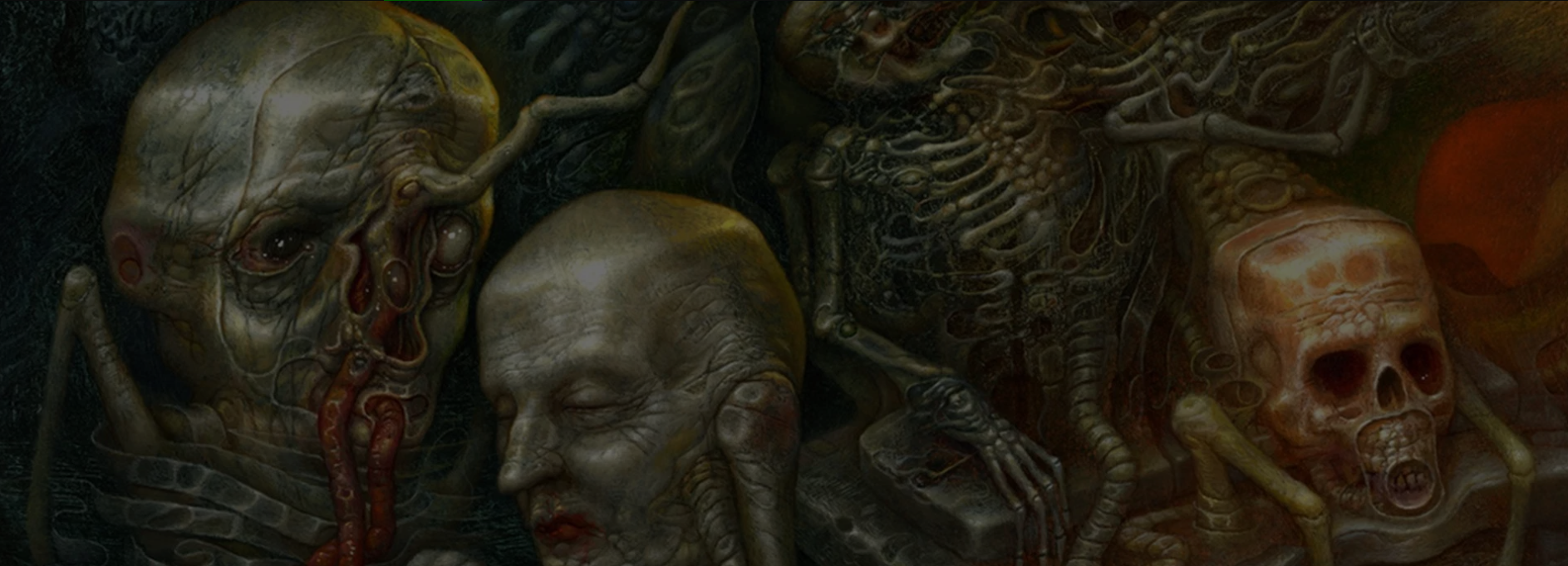
My otherwise-quite-suitable life-partner and I seem to address this topic quite often, still, even after more than twenty-three years together: Why the hell do I like such horrible things? (In case you’re wondering, this oft-visited discussion is rarely instigated by me.) I’m not just talking about music, though of course music is one of the many areas where this ‘Mat likes horrible things’ rule is undeniably true. I’m talking art in general, whether it’s sound or visual art; I’m talking movies, whether it’s disturbing cinema or silly monster movies or films causing severe psychological discomfort; but I’m also talking about actively researching/hunting down and reading about the various assorted true depravities committed by the ever-creative-in-this-department mass of humankind. Horribleness. Miscellaneous vileness. Ugliness of the form and spirit. I seem drawn to it, and always have been, ever since I can remember. And, given the extremity of topic/sound/aesthetic surrounding this article, the odds are strong that you too, Heathen Harvester, are just as drawn to the deplorable as I am. The question I want to investigate here is: why?
Because it’s not all of us that dig this shit. There are a great many people (as frequently brought up as some kind of evidence by my aforementioned otherwise-quite-suitable life-partner) who don’t like ugliness/horror/depravity at all, and in fact spend a good deal of time deliberately avoiding such matters, choosing to spend their finite hours on this planet enjoying things that are, well, enjoyable. Instead of, say, looking up uncensored footage of prison stabbings, they’ll read an article on, I don’t know, propagating kale, or look at pictures of animals with amusing expressions, or, I don’t know, something else. I honestly have no idea. Because I’m too busy watching grainy footage of people shivving each other in the weights yard.
 And I’ve always been this way. The earliest memory I have of being drawn to the monstrous was as a very young child, watching Doctor Who (I’ve since rummaged through my old stuff and have found a tiny notepad my mum used to keep, which is full of her painstaking re-drawings of my drawings when I was little, and have found a picture of Doctor Who and his companion Sarah Jane which mum dated sixth of August 1978, meaning I was about three and a half). I seem to recall some green slimy eyeball-type creature shambling up the side of a lighthouse, and I remember loving it soooo much. (I clearly also remember mum telling dad that my love of the bizarre and frightening was ‘just a phase’, which is pretty damn funny in hindsight.) But why did I love it so much? Was it just a love of the impossible, the fantastical? Or was it just some very normal thing that I never grew out of (I mean, all kids love monsters, don’t they?)—in which case, why didn’t I grow out of it?
Some of us seem drawn to ugly art, strange music, and real-life depravity, and some of us don’t. I have an inkling that the two are related (being drawn to ugly strangeness in sound/vision, and being interested in ugly strangeness in real life), but of course nothing is ever actually that simple, and I definitely know people who refuse to watch scary/freaky movies but insist on weird/noisy music at all times, so I’m pretty sure whatever conclusions I come up with will be highly variable in their personal mileage, and the whole lumping-this-all-together thing I’m attempting here may very well be a terrible mistake. But, well, I’m going to attempt it anyway.
So, first stop… monstrousness in fantasy/art/sound/imagination.
My otherwise-quite-suitable life-partner has a simple rule: no screaming in the lounge room (at least, not with her around). This doesn’t refer to my own screaming (I am a very quiet chap in general, softly-spoken with a tendency to mumble incoherently), but rather the screaming of the vocalists in the musical projects that I choose to listen to: Nocturno Culto, Utarm, Katherine Katz, Mories, Nekrasov, Jay Randall, Passenger of Shit, J R Hayes, etc. (not to mention the even more ‘non-vocalist’-type screams of bands like Abruptum and Stalaggh/Gulaggh). She can tolerate the more tuneful-type screams of Devin Townsend, but that’s about her limit: otherwise, any part of our house that isn’t my dimly lit (and expertly soundproofed) underhouse studio is simply a no-scream zone. Which is fair enough. After all, human screams are one of the sounds we’re almost biologically attuned to dislike, either through empathy or revulsion. So why does so much of the music I like contain so damn much of the stuff? The same goes for immense amounts of atonality, or for overwhelming cut-up chaos (without repetition or pattern or structure): These things are, as a rule, disorienting and/or anxiety-inducing, so why the fuck do I chase it so much? Why does something in me light up when it gets sonically flummoxed, when the same thing drives other (normal) people away? And why are you like that too? What happened to us? Are we damaged?
I suspect this is roughly how my otherwise-quite-suitable life-partner sees it: that I turned out “wrong” somehow, that I’m a bit “broken”. But I also suspect that this view is completely inaccurate. Because I just don’t feel very broken. I feel fine, generally speaking. It’s not like I’m drawn to this chaos or darkness or phantasmagorical pain because it’s only then that I feel at home, or because it’s only horror that makes me feel like someone understands my hellish existence, or that it’s the only way I can experience healing catharsis, or anything like that. It’s not like I need horrible screaming people in my lounge room. It honestly feels like it’s purely a taste thing, an aesthetic that I’m drawn to. I just like horrible screaming people, ugly visions, inappropriate textures, and sordidness of spirit. I just do. But, of course, this is exactly the issue I’m attempting to investigate here: the reasons behind this taste, and the reasons why I’m drawn to this particular aesthetic, given that the whole human experience is typically about avoiding the same (shunning the ugly, moving away from the screaming person, not submerging oneself in grossness, etc.).
To help with writing this essay, I’ve just gone and read up on what draws people to horror movies (as an example of the ‘monstrous in art’), and it turns out there’s a million different theories:
1) There’s the theory that watching a scary/freaky movie makes one’s heart rate, blood pressure, and breathing intensify, which kind of experientially heightens the feelings associated with watching it, so, if you’re having a great time watching, it’ll feel like an ever greater time, relatively speaking, because your system is on such high alert. This theory also lends itself to musical experiences: If all that atonality and screaming and super-speedy beatmongering (or super-loud doom-vibes) cause your biological system to become heightened, and you’re having a great time listening, then it’ll become an even greater time, relatively speaking. This theory also ties into the idea of some people totally digging it, and some people totally not digging it, because this theory also says that if you’re having a bad time watching/listening, the bad experience will be made even more unpleasant by the same heightened biological states. But what this theory doesn’t really help with is why the monstrous thing is enjoyable in the first place. It only really deals with how the heightened experience makes the reaction stronger than other forms of media.

Still from Taxidermia
2) There’s a theory that it is the heightened excitation itself that we enjoy, in the same way as a base-jumper enjoys leaping off things or a rollercoaster-fan enjoys screaming in abject terror and barfing their guts up (assuming that’s what people enjoy about rollercoasters). We get off on the feeling of it. And, even better than a rollercoaster, watching a scary movie, or listening to a disorienting album is an intrinsically safe way to go about getting this hit of heightened excitation. There may be some merit to this theory; there is definitely some kind of a buzz that I get from these forms of media, and yet I am just as definitely not the kind of person who goes jumping off cliffs (and last time I was on a fairground ride with my daughter I vowed never to fucking do that shit ever again). But at the same time, I don’t feel like it’s the whole story, because there’s many a time I’ll want to listen to some extreme metal or crazy cut-up nonsense and not feel like I’m ‘chasing a buzz’ at all, but rather, just ‘having a nice time’.
3) There’s a theory that it’s the enjoyment of triumphing over fear/repulsion itself that we enjoy—that, in essence, we enjoy these terrible things because they are unenjoyable, and being able to show them who’s boss is what gives us the positive feelings. It’s like we’re giving the Grim Reaper the finger, in some sense, like we’re reducing the hideous/terrifying/ghastly/repulsive to mere entertainment, and that is what feels good. It feels like there might be some merit in this theory too, perhaps: It is kinda cool to be able to say, ‘You can’t handle Whourkr or Utarm? I love those bands.’ But this theory does reduce the entirety of enjoying the Art of the Horrendous to some kind of show-offy bullshit pretence, which it really doesn’t feel like, and makes the experience all about proving yourself to others, which it also doesn’t really feel like. When I listen to full-on strangeness or watch Visitor Q, I tend to do it on my own, without anyone else in mind, and enjoy the experience wholly on my own terms, without anyone else’s validation or respect or values on my mind (and, as mentioned earlier, the enjoyment of such media actually makes my otherwise-quite-suitable life-partner respect me less). So, although there may be an element of this involved, it doesn’t feel like it’s the whole picture. (There is, of course, that thing of proving to yourself that you can handle something scary, but, for most of us who are actually into The Strange, that’s a no-brainer: We already know we can handle it because it’s the kind of thing we regularly seek out and experience, so it’s not so much of an issue. I think there probably is an element of it involved [especially in the escalating scale of the ugliness we may seek out], but it’s definitely not the whole story.)
4) There’s the theory that male-identifying people are drawn to scary movies because they get gender reinforcement by ‘proving themselves’ in the face of fear/repulsion (‘lack of fear in the face of terror’ being a cultural marker for assessing masculinity). One study (a ridiculously small one, with only thirty-six people of very limited diversity) showed that male-identifying people enjoyed a horror movie more when they watched it with a female-identifying person who was scared, and female-identifying people enjoyed the horror movie more when they watched it with a male-identifying person who wasn’t scared. I suspect this is actually rank codswallop, given the male—and female—identifying people I personally know, but could very well be a factor for a more mainstream population. What would I know? Either way, it doesn’t really answer my particular question though, and is much harder to shift across to other art forms—if these effects are remotely true in the first place, does listening to strange/ugly music produce similar effects (i.e., do chicks like listening to hideous noise if there’s a manly man around)? Certainly my otherwise-quite-suitable life-partner has never once found my ever-so-masculine tolerance of unpleasant music/cinema even remotely erogenous. As suggested earlier: rank codswallop.
5) There’s a theory that says we are drawn to horror/strangeness/ugliness because it is outside of our normal realm of experience, and, as such, becomes imbued with the Imaginary Value of the Rare. In the same way as people care more about cheetahs than they do about pigs, or diamonds more than they care about bread, the very novelty of the horrendous makes it worth something. Biologically, we are hardwired to look for anomalies in our environment, and curiosity about The Strange is a sensible survival technique. It may very well be that we are drawn to horror movies/weird music/ghastly stories for the very same reasons we rubberneck at a car crash. A normal person’s morbid fascination and my unending hunt for intriguing new sounds are basically rooted in the same biological thing.

Still from Martyrs
Now, when I saw this theory, it made a small ‘ching’ noise in my mental theatre, like a little gold bell struck once with a tiny hammer, because this is actually something I am consciously aware of in my search for interesting music/art/cinema. I love nothing more than hearing some piece of music and thinking, ‘Fuck, I have never heard that before’. When I make music, it’s always with the intention of adding something to the world that doesn’t already exist. When I review an album, I’m always asking myself, ‘Is this just a pile of self-conscious cookie-cutter swill, or is this actually something worthwhile?’ So, seeing this concept of novelty applied to horror movies was actually a bit of an eye-opener. I’d never thought of it that way before. My interest in the dark/ugly/strange side of media is all linked by a conceptual interest in the far borders of human experience—in experiencing the very fringes of the normal/socially permissible. I don’t want to jump off a cliff, but I’m deeply drawn to music/visuals/emotions that do (metaphorically speaking). It’s not actually an attraction to the repulsive, it’s an attraction to the strange, and, by its very nature, the strange includes all those things that don’t fit into the normal. And, since the normal spends so much time appreciating/collecting beauty and pleasantry and comfort, the strange ends up including the ugly and unpleasant and discomforting! I’m not broken after all! I just like weirdness, which happens to include ugliness and horror! It may be that the part of me that lit up when I first heard Alvin and the Chipmunks is the exact same part of me that got a buzz out of Martyrs.
It does all make sense, that all this interest in The Repulsive stems from a blanket interest in The Strange. Most of the other people I know who share this obsession with the macabre/ugly have similar interests in Surrealism, the Occult, dreams, etc. Being raised in a slick corporate world of ego-driven fitness, photoshopped beauty, and community as PR, it’s no surprise that some of us were drawn to the things we weren’t meant to see, and sided with ugliness instead. Like the underarm hair on a fashion model, there are many things that are true and real and natural that our society attempts to erase in the name of capitalist fear-mongering and mind control, and it is no surprise that some of us opted for the forbidden (sometimes for no other reason than it was forbidden in the first place).

Blood Dumpling Envy by Chris Mars
Still with me? Great! This paragraph or so of ‘rubbernecking at car crashes’ seems the perfect segue to take us to the next, quite a bit more disturbing, level of this journey of the horrendous: our interest in true horror (because it’s not just fantasy stuff we’re into). The kind of person I’m talking about here (okay, so basically me at this stage, but I’m hoping there are enough of you out there to justify the effort involved in writing and publishing this essay), this kind of person doesn’t just watch Taxidermia and listen to Gnaw Their Tongues and enjoy the painted works of Chris Mars (and bonus points to any of you who ticked off all three boxes there). It’s not just in the phantasmagorical realm that we’re drawn to ghastliness, but in the real. The kind of person I’m talking about also reads true crime stories (the more aberrant the better) and searches out photos of things made of human skin. This kind of person finds themselves late at night perusing the sickening online transcripts of the instructional cassette tape David Parker Ray (AKA the Toybox Killer) recorded for his bound and gagged kidnapping victims to listen to as they awoke on his torture table. Because (I think) part of this interest in the great horror is not merely titillation or car-crash rubbernecking, but in unlocking something about what it means to be human—where the lines of experience are drawn, and what’s at the very edges of that terrain. So, level two: Hold on tight.
Now, before we get to this level, let’s make it clear: Horror is still horror to me. It’s not fun. The ugly is still ugly. It’s not like I’m here going, ‘It’s so cool when people get hurt or have bad times’. It’s not like that at all. It’s something like eating a really hot chili: It still hurts, lots, but there is some kind of intensity to the pain itself that can be enjoyed, while the burning is still really not enjoyable at all. You can enjoy the intensity itself while still registering the pain as painful. There’s an excitement to the extremity of the badness while still fully recognising the badness is bad. Like the car crash we drive past, craning for corpses: We know those corpses are real people, like everyone we love, and that those corpses represent a whole world of sadness and pain for other very real people, but at the same time, it’d be kinda cool to cop an eyeful.
So, drawing on all the theories above, do they still apply when the horror is not some kind of aesthetic choice, but a real-life tragedy? Is it okay to get a buzz out of genuine misfortune? Is it okay to be interested in the very darkest parts of the human organism? Hasn’t it crossed some line now into sickness and depravity? I argue it hasn’t, as long as we keep that previous point in mind: that bad shit is actually really fucking bad. My interest in the true horrors of the world is actually miles away from ‘fun’. It has elements of ‘attraction to novelty’ about it, it has elements of ‘triumphing over fear’, but it is never, ever ‘having a cool time’. It’s definitely an interest in the aberrant while being fucking endlessly gratitudinously thankful that it is an aberration and not the norm. It’s a much more serious business than listening to some wacky music or watching a bunch of actors pretend to be scared: This is intrinsically linked to that stuff about experiencing the very borders of human experience and knowing what’s really going on. It’s pretty fucked, but I feel better knowing just how fucked it actually is.

Collected Atrocities 2005-2008 by Gnaw Their Tongues
And sometimes it really does leave me scarred—sometimes permanently so. That late night when I discovered myself reading what David Parker Ray had to say to his victims, I felt physically ill. I was shaking with the horror of it all—that this shit was fucking real, this actually happened to people as flesh-and-blood as I am, as my daughter is. I actually felt like I was having a panic attack. It was not fun. And yet I read it to the end and went hunting for more information, pictures, and testimonies in some kind of horrified fact-hunting fugue.
I had a similar reaction when reading about one researcher’s infiltration of the child pornography community on the Deep Web. What I read there fucking completely freaked me out for a long time (families raising kids specifically for ‘sharing’; the schism between the anti-violence and pro-violence factions; the mind-boggling scale of it all). But that didn’t stop me poking around the dark corners of reality, because, well, just because something is mind-boggling horrible doesn’t mean I should put my fingers in my ears and go ‘la la la’ in the hopes that it will go away. It won’t.
When it comes to fictional depravity, I think the simple notions of ‘novelty’ and ‘triumph over horror’ might come into play, but when it comes to this far-scarier, far-more-awful real life horror, I think another element comes to the fore, namely knowing what’s really going on. I like to think it’s the attraction of knowledge, pure unrefined warty-balls-and-all knowledge itself, that draws me in. (But of course, I’m not scouring astrophysicist sites for knowledge; I’m not trawling marine biology sites for knowledge; it’s simply not the case that it’s ‘just knowledge’ that interests me. It’s very definitely ‘knowledge about things that are horrible’ that attracts me. So, what is it about that knowledge regarding specifically horrendous, fucking ghastly shit that interests me? Is it the ‘triumphing over fear’ stuff investigated above? Is it the ‘fringes of experience’ stuff?)
I think, in the end, it’s some kind of a desperate attempt to understand what we’re capable of—what I, as a human being, must be capable of. When I talk about an interest in exploring ‘the fringes of human experience’, I wonder if, deep down, it’s actually about exploring what I could be capable of—what you could be capable of. It’s about what any of us could be capable of. Because we’re all the same species, exactly the same species, as David Parker Ray or Jeffrey Dahmer or Elizabeth Bathory. Anything they could do (I’m not talking about feats of strength or remarkable agility here), I could do, or you could do. And yet, somehow, through some amazing conjunction of circumstances, we don’t do these terrible, fucked up things. And that feels great.
When we know just how horrible things can be, it gives us two things:
1) We are armed with the shining scimitar of actual truth, and
2) We are filled with the glowing light of gratitude that whatever foul fucking piece of disaster we’ve just finished consuming is not, in fact, happening to us right now.
And truth and gratitude, I think, may be worth more than a little horror.
In closing, what have I learned? I think the most important thing here is that an interest in the strange is not necessarily a problem or some kind of symptom of a broken person, or something that we should be concerned about in our young ones, or anything like that. An interest in the strange can definitely bring people into contact with horrible, horrible things and can definitely make the soundtrack of your lounge room less comfortable for your significant others, but it can also bring a lot of truth into your lives. Unpleasant, awful, trauma-inspiring truth, but truth nonetheless. As a vegan-type person, I’ve definitely seen a lot more trauma-inspiring footage than most mainstreamer corpse-eating-type people, but I can’t help but feel that if I have to choose between comfortable illusion and uncomfortable truth, I’ll always end up choosing to know the ugly facts. It’s a bit like that.
In the end, I’m not actually saying, ‘I listen to weird music, which is somehow loosely tied into valuing truth more than people who listen to mainstream music, so I’m a better person than you’. I’m not actually saying, ‘People who only listen to carefully sanitised, executively driven, corporately produced music are somehow trapped in an inauthentic world of capitalist product-driven illusion, and I’m not, so nyer’. I’m not really saying, ‘Weirdness is better, straight people suck massive dogballs’. Or am I?
Maybe, deep down, I am saying that. And maybe this is really just me petulantly getting back at everyone who ever called me a weirdo. How can I possibly tell? Funny how the subconscious works.