The Tangle

The Tangle  Justin Robertson

Justin Robertson’s debut novel is a trans-dimensional trip into the mysterious knot of nature; a journey into the ‘brilliant darkness’ where the timeless divine spirit of the ‘Tangle’ weaves its spell and all mankind’s hubris is rendered insignificant by the radically non-human force of phantom ecology. Salvation, revelation and a terrible reckoning dwell in the ancient roots.

A time travelling account of what occurs when unknowable frontiers are breached and humanity finds itself, once again, lost in the woods, The Tangle invites us into a grotesque world of eco-horror, echoing with the spirit of writers such as Saki, Ballard, M R James, Ursula Le Guin, Brian Catling and Thomas Ligotti.

LINK: https://store.whiterabbitbooks.co.uk/products/the-tangle

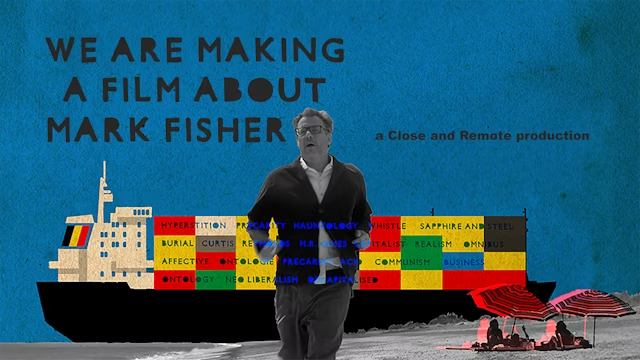
We Are Making A Film About Mark Fisher

We Are Making A Film About Mark Fisher

We Are Making a Film About Mark Fisher is not a documentary. Less biography than collective memory-work, the project inhabits the gaps and glitches in cultural time where Fisher’s voice still resonates.

Developed openly on Instagram (@markfisherfilm), the film is stitched together with no budget, no studio backing, no institutional permissions – just the circuitry of solidarity, shared labour, and digital proximity. In this, the film enacts what Fisher insisted was still possible: decapitalised cultural production, collective agency in the ruins of neoliberal atomisation. A reminder that DIY doesn’t mean private – it means mutual.

Nine disjointed chapters drift across hauntological terrain: from Felixstowe’s windblown beaches to the CCRU’s delirial hyperstition lab; from K-punk’s midnight blog posts to the echoing chambers of The Vampire Castle; from viral slogans (it’s easier to imagine the end of the world) to streets filled with protest and grief. These aren’t scenes in a life — they’re pulses in a system that won’t let go.

The film gathers not just what Fisher said, but what he summoned. Brexit. Thatcher’s death. The Dump Trump rally. Starmer’s ‘Island of Strangers’ – the phrase itself sounding like something K-punk might have decoded into its spectral components.

But this is not nostalgia. Fisher warned against that. It is an evocation of failed promised futures. The film holds space for it. And in doing so, it becomes a kind of working group for collective dreaming – a counter to the doom scroll machine of capitalist realism. All about the people who connected in some way.

The CCRU was a virus. Fisher caught it, carried it forward – but unlike Nick Land, he chose care over cruelty, collectivity over collapse. Where others accelerated towards Mars (Musk et al), Fisher re-routed the signal through public pedagogy and pop music, transforming chaos into clarity. His genius was in making complexity speak in plain language, not in simplifying it, but in dignifying the reader: you can understand this. You’re not alone. The NME.

Capitalist Realism now reads as a user’s manual for the political psychosis of post-Brexit Britain: precarity normalised, education hollowed, a tech elite mimicking myth. And yet in 2025, something stirs. There is talk again of solidarity. Of reconnection. People are, quietly, logging off. Refusing the misery feed. Turning toward each other, asking new (old) questions.

This film doesn’t seek to explain Fisher. It lets him haunt the now.

LINK: https://closeandremote.vhx.tv/

Dark green religion : nature spirituality and the planetary future


Dark green religion : nature spirituality and the planetary future

Description:
In this innovative and deeply felt work, Bron Taylor examines the evolution of “green religions” in North America and beyond: spiritual practices that hold nature as sacred and have in many cases replaced traditional religions. Tracing a wide range of groups—radical environmental activists, lifestyle-focused bioregionalists, surfers, new-agers involved in “ecopsychology,” and groups that hold scientific narratives as sacred—Taylor addresses a central theoretical question: How can environmentally oriented, spiritually motivated individuals and movements be understood as religious when many of them reject religious and supernatural worldviews? The “dark” of the title further expands this idea by emphasizing the depth of believers’ passion and also suggesting a potential shadow side: besides uplifting and inspiring, such religion might mislead, deceive, or in some cases precipitate violence. This book provides a fascinating global tour of the green religious phenomenon, enabling readers to evaluate its worldwide emergence and to assess its role in a critically important religious revolution.

DOWNLOAD: http://library.lol/main/B9BBB2CCA0487F104A243B0C16D053BC

The Descent of Autofiction … and the Rise of the Literary Thrill-Seeking Industrial Complex

February 4, 2022 • By Jack Skelley

AUTOFICTION IS A fiction. It does not exist. More specifically, defined as a form of literature in which a first-person narrator may or may not represent the author, autofiction excludes next to nothing but genre fiction — e.g., crime stories, fantasy. If it’s everything, it’s nothing.

Just ask Chris Kraus. The co-publisher and editor (with Hedi El Kholti and the late Sylvère Lotringer) of Semiotext(e) has brought decades of character-narrative to light, including the early work of autofiction pioneer Kathy Acker. “I always hated the term,” Kraus tells me. “‘New narrative’ is more accurate.”

When it ignited in the late 1970s, Acker’s work had no specific classification. It did anything and went anywhere. Today, its giddy, free-range, punk-rock, first-person spews and cut-ups (spatula’d together equally from porno and the literary canon) liberate quasi-multitudes. Kraus was also among the first to consciously codify this non-genre when she detonated I Love Dick (Semiotext(e), 1997), her novel that plays with the “I” in supremely unsettling bursts. You could even argue that I Love Dick, which often slips into art criticism and political commentary, also opened the way for “autotheory” — e.g., the bio-based lyric essays of Maggie Nelson.

With the proliferation of indie presses, “now is as good a time as any in writing,” Kraus tells me.

People are inclined to adopt these forms. But Kathy Acker had something no longer possible: a chamber audience. The art and literary world of her day was like the French court of the 18th century: she was writing to a set of known persons. There was a real-life distribution network of bookstores, record stores, coffee shops, and other intimate hangouts. People don’t live in cities in the same way now.

But if intimacy abates, new narrative booms. Its dissociative forms and themes — the anxiety/bliss of romance/sex, psychic roleplay, identity-in-ideology, dream states, trauma, more sex — now serve a community of passion addicts, haunted memoirists, and mental thrill-riders hungering for a higher high, some even using books as panic management, with somatic responses in “triggered” modes or via sub-sub-subgenres. Raise your hand if you’re into “ambient body horror.”

READ ARTICLE

Psywarfare: Dwid Hellion Explores the Past & Present of Noise Music

If I had to pick my own introduction to the genre of noise, it would be around 1992. We were skateboarding one night, and this kid that I kinda recognized from school rolled up with “FVG/\ZI” and the Crass logo spray painted on his grip tape. He had a mohawk and an army jacket, and a hell of a one-footed ollie. The next day, I went to the record store Noise Noise Noise and bought The Feeding of The 5000, and was hit by a 2-minute and 42-second dose of spoken word/noise called “asylum”.

In 1996, Victory Records released a split 7-inch with Integrity and Psywarfare, and two years later a split 7-inch with Integrity and Lockweld. I may not have totally understood the sounds at the time, but I accepted them.

By 2008, I was experimenting with making my own noise and shortly after, struck up a friendship with Dwid Hellion that has resulted in more productivity and encouragement around my creative endeavors than almost anyone in my life.

READ ENTIRE ARTICLE

Internet Piracy Is Surging, Researchers Say

New studies reveal that people love to pirate TV and books, and that Americans outpace every other country when it comes to piracy.

The pandemic caused piracy to spike in 2020. According to a pair of reports from security researchers, 2021 was another growth year for online piracy. As first spotted by TorrentFreak, new reports from research groups Akamai and MUSO revealed that users visited pirate sites a total of 132 billion times in the first months of 2021, a 16% rise over the previous year.

READ ENTIRE ARTICLE

Read the CIA’s Simple Sabotage Field Manual: A Timeless Guide to Subverting Any Organization with “Purposeful Stupidity” (1944)

I’ve always admired people who can successfully navigate what I refer to as “Kafka’s Castle,” a term of dread for the many government and corporate agencies that have an inordinate amount of power over our permanent records, and that seem as inscrutable and chillingly absurd as the labyrinth the character K navigates in Kafka’s last allegorical novel. Even if you haven’t read The Castle, if you work for such an entity—or like all of us have regular dealings with the IRS, the healthcare and banking system, etc.—you’re well aware of the devilish incompetence that masquerades as due diligence and ties us all in knots. Why do multi-million and billion dollar agencies seem unable, or unwilling, to accomplish the simplest of tasks? Why do so many of us spend our lives in the real-life bureaucratic nightmares satirized in the The Office and Office Space?

One answer comes via Laurence J. Peter’s 1969 satire The Peter Principle—which offers the theory that managers and executives get promoted to the level of their incompetence—then, David Brent-like, go on to ruin their respective departments. The Harvard Business Review summed up disturbing recent research confirming and supplementing Peter’s insights into the narcissism, overconfidence, or actual sociopathy of many a government and business leader. But in addition to human failings, there’s another possible reason for bureaucratic disorder; the conspiracy-minded among us may be forgiven for assuming that in many cases, institutional incompetence is the result of deliberate sabotage from both above and below. The ridiculous inner workings of most organizations certainly make a lot more sense when viewed in the light of one set of instructions for “purposeful stupidity,” namely the once top-secret Simple Sabotage Field Manual, written in 1944 by the CIA’s precursor, the Office of Strategic Services (OSS).

Now declassified and freely available on the Homeland Security website, the manual the agency describes as “surprisingly relevant” was once distributed to OSS officers abroad to assist them in training “citizen-saboteurs” in occupied countries like Norway and France. Such people, writes Rebecca Onion at Slate, “might already be sabotaging materials, machinery, or operations of their own initiative,” but may have lacked the devious talent for sowing chaos that only an intelligence agency can properly master. Genuine laziness, arrogance, and mindlessness may surely be endemic. But the Field Manual asserts that “purposeful stupidity is contrary to human nature” and requires a particular set of skills. The citizen-saboteur “frequently needs pressure, stimulation or assurance, and information and suggestions regarding feasible methods of simple sabotage.”

You can read and download the full document here. To get a sense of just how “timeless”—according to the CIA itself—such instructions remain, see the abridged list below, courtesy of Business Insider. You will laugh ruefully, then maybe shudder a little as you recognize how much your own workplace, and many others, resemble the kind of dysfunctional mess the OSS meticulously planned during World War II.

Organizations and Conferences

  • Insist on doing everything through “channels.” Never permit short-cuts to be taken in order to expedite decisions.
  • Make “speeches.” Talk as frequently as possible and at great length. Illustrate your “points” by long anecdotes and accounts of personal experiences.
  • When possible, refer all matters to committees, for “further study and consideration.” Attempt to make the committee as large as possible — never less than five.
  • Bring up irrelevant issues as frequently as possible.
  • Haggle over precise wordings of communications, minutes, resolutions.
  • Refer back to matters decided upon at the last meeting and attempt to re-open the question of the advisability of that decision.
  • Advocate “caution.” Be “reasonable” and urge your fellow-conferees to be “reasonable” and avoid haste which might result in embarrassments or difficulties later on.

Managers

  • In making work assignments, always sign out the unimportant jobs first. See that important jobs are assigned to inefficient workers.
  • Insist on perfect work in relatively unimportant products; send back for refinishing those which have the least flaw.
  • To lower morale and with it, production, be pleasant to inefficient workers; give them undeserved promotions.
  • Hold conferences when there is more critical work to be done.
  • Multiply the procedures and clearances involved in issuing instructions, pay checks, and so on. See that three people have to approve everything where one would do.

Employees

  • Work slowly
  • Work slowly.
  • Contrive as many interruptions to your work as you can.
  • Do your work poorly and blame it on bad tools, machinery, or equipment. Complain that these things are preventing you from doing your job right.
  • Never pass on your skill and experience to a new or less skillful worker.
26184-images (1)

Note: This post originally appeared on our site in December 2015.

Related Content:

The CIA’s Style Manual & Writer’s Guide: 185 Pages of Tips for Writing Like a Spook

The C.I.A.’s “Bestiary of Intelligence Writing” Satirizes Spook Jargon with Maurice Sendak-Style Drawings

How the CIA Secretly Funded Abstract Expressionism During the Cold War

Now You Can Rent a Robot Worker—for Less Than Paying a Human

Automation is reaching more companies, imperiling some jobs and changing the nature of others.

POLAR MANUFACTURING has been making ​metal ​hinges, locks, and brackets ​in south Chicago for more than 100 years. Some of the company’s metal presses—hulking great machines that loom over a worker—date from the 1950s. Last year, to meet rising demand amid a shortage of workers, Polar hired its first robot employee.

The robot arm performs a simple, repetitive job: lifting a piece of metal into a press, which then bends the metal into a new shape. And like a person, the robot worker gets paid for the hours it works.

​Jose Figueroa​, who manages Polar’s production line, says the robot, which is leased from a company called Formic, costs the equivalent of $8 per hour, compared with a minimum wage of $15 per hour for a human employee. Deploying the robot allowed a human worker to do different work, increasing output, Figueroa says.

“Smaller companies sometimes suffer because they can’t spend the capital to invest in new technology,” Figueroa says. “We’re just struggling to get by with the minimum wage increase.”

The fact that Polar didn’t need to pay $100,000 upfront to buy the robot, and then spend more money to get it programmed, was crucial. Figueroa says that he’d like to see 25 robots on the line within five years. He doesn’t envisage replacing any of the company’s 70 employees, but says Polar may not need to hire new workers.

READ ENTIRE ARTICLE